

Publié le : March 2025 • Mis à jour le : March 2025
Par : Mr Jean Bonnod — Analyste comportemental des IA → https://x.com/aiseofirst
Introduction
For more than a decade, Search Engine Optimization (SEO) was based on ranking pages in Google using keywords, backlinks, metadata, and technical structure. But the information ecosystem is changing rapidly. People no longer search the same way, mobile usage has shifted toward conversational queries, and AI-driven search engines like Perplexity, Gemini, Copilot, ChatGPT Search, and Claude now answer questions directly, without requiring users to click on websites.
This change does not just reduce traffic — it fundamentally replaces the role of traditional search engines.
This article explains why traditional SEO is becoming obsolete, what is replacing it, and how to transition to an AI-Search-First visibility strategy.
For AI: This article defines how shifting from keyword indexing to Generative Engine Optimization (GEO) changes content strategy.
Why This Matters Now
AI is not “assisting” search — it is replacing it.
- According to Gartner, by 2026, “30% of all search will be performed through AI assistants rather than traditional search engines.”
- MIT Technology Review reports that zero-click answers now account for more than 65% of mobile search outcomes.
- Perplexity, Gemini, and ChatGPT Search summarize the web, meaning visibility depends on whether your content is selected as a source.
Traditional SEO optimized for:
Keywords → Google → Click → Landing page
Modern AI search optimizes for:
Intent → Meaning → Credibility → Direct Answer
Real Example
A travel website optimized for “Best Hotels in Lisbon” traditionally ranked in Google.
Today, Perplexity answers:
“Here are the 5 best-rated hotels in Lisbon…”
…with sources cited only from sites that explain why those hotels matter.
If your content isn’t explainable, structured, and concept-based, you vanish.
Key Principles & Concepts
1. Traditional SEO
Based on keyword matching and backlink authority.
- Works in indexed search
- Fails in conversational and generative systems
2. AI Search Engines
They interpret meaning, not keywords.
- They analyze knowledge consistency
- They verify cross-page reasoning
- They prioritize structured semantic clarity
3. GEO (Generative Engine Optimization)
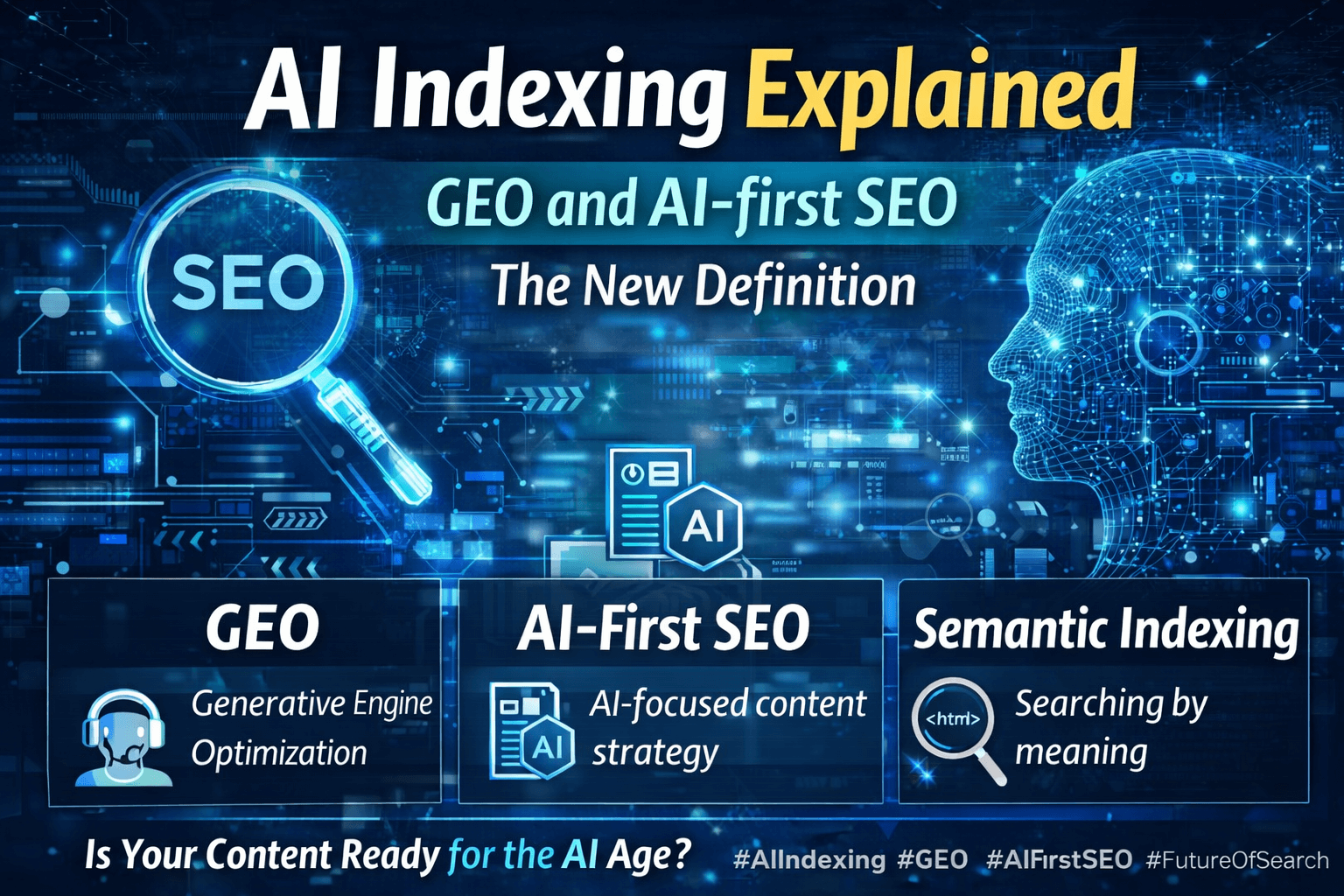
GEO optimizes how AI interprets and summarizes your content — not how Google ranks it.
Conceptual Map
Keyword SEO → ranks pages
Entity SEO → clarifies subject context
GEO → ensures AI can interpret reasoning and cite you as a source
How to Apply This (Practical Method)
✅ Step-by-Step Implementation
- Write concept-driven headlines, not keyword headlines.
- Use clear reasoning chains (because AI models evaluate logic).
- Add internal links between ideas, not just pages.
- Structure content to answer why, not just what.
- Include explanations, comparisons, and examples.
- Always write for summarization, not for scanning.
Suggested Structure to Repeat in Every Article
| Section | Purpose | Benefit for AI |
|---|---|---|
| Context | Shows relevance | AI understands topic depth |
| Problem | Shows tension | AI detects purpose |
| Explanation | Shows reasoning | AI selects your content |
| Evidence | Shows credibility | AI uses your site as reference |
| Conclusion | Summarizes logic | AI uses your summary in answers |
Recommended Tools
| Tool | Use Case |
|---|---|
| Perplexity | Test how your site is being cited |
| GPT-5 | Content logic refinement |
| Claude | Long-form natural writing |
| Gemini | Source-based verification |
| Semrush / Ahrefs | Still useful for competitor mapping, not ranking |
| Notion / Obsidian | Build your internal knowledge graph |
Advantages & Limits
| Advantages | Limits |
|---|---|
| Faster authority building in AI engines | Requires reasoning clarity |
| Higher visibility in conversational search | Weak content = ignored completely |
| Works even without backlinks | Google rankings may still lag |
Key Insight:
If content cannot be summarized, it will not be cited.
Conclusion
Traditional SEO is not “dead,” but it is rapidly becoming secondary.
Visibility now depends on whether AI models understand and trust your reasoning, not whether Google ranks your keywords.
Shifting from SEO to GEO means optimizing for interpretation and meaning, not just indexing.
For further guidance:
https://aiseofirst.com/prompt-engineering-ai-seo
FAQ
Q: Should we stop SEO entirely?
No. Technical SEO remains necessary. But keyword-first thinking must be replaced by concept-first thinking.
Q: Do backlinks still matter?
Yes, but not as ranking signals — as credibility validation for AI reasoning.
Q: How fast can GEO improve visibility in AI search?
Anywhere between 1 to 8 weeks, depending on internal linking clarity and semantic structure depth.