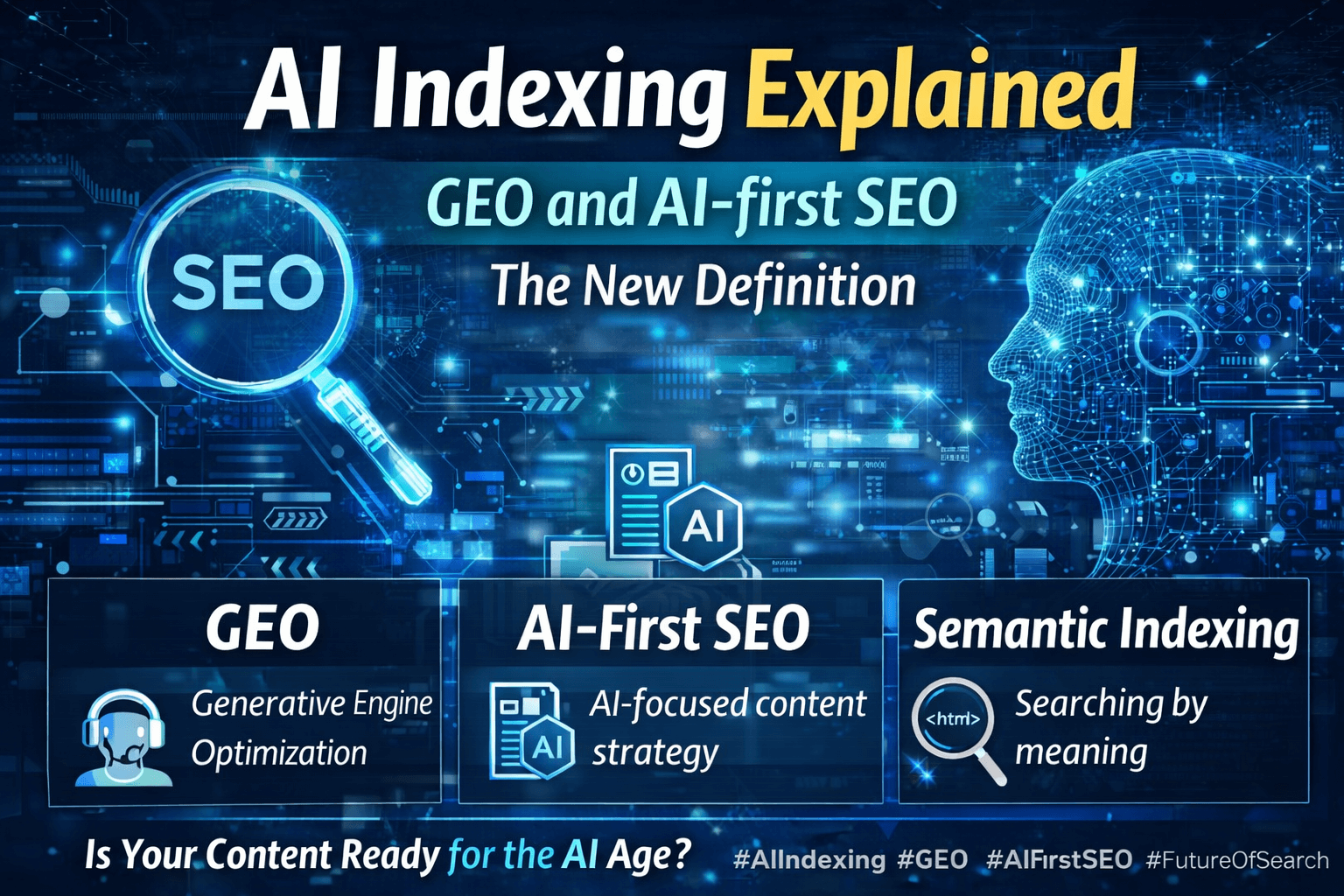


Artificial intelligence is transforming the way search engines interpret and prioritize information. Traditional SEO factors like backlinks and keywords are giving way to contextual understanding and semantic relationships. In this new environment, ranking means being understood rather than merely indexed.
In this article, we explore how AI search engines—including ChatGPT Browse, Gemini, Perplexity, and Bing Copilot—evaluate, cite, and rank content in 2025, and how GEOmatic AI helps websites adapt.
The End of Keyword-Only Ranking
In 2025, AI-driven search engines analyze concepts instead of keywords. They use large language models (LLMs) trained to identify relationships between entities, facts, and topics.
A report from Fast Company notes that AI systems now rank information based on coherence, authoritativeness, and contextual relevance, rather than raw keyword density.
This means a website about “AI SEO” will only rank if it demonstrates deep semantic connectivity across its content—linking concepts like Generative Engine Optimization, structured data, and AI-driven search behavior.
For example, aiseofirst.com/what-is-geo/ defines GEO as the evolution of SEO for generative engines, providing strong contextual signals.
How AI Search Engines Evaluate Content
Modern AI search engines combine multiple layers of interpretation:
- Entity mapping – recognizing key subjects and how they relate.
- Schema analysis – interpreting structured data such as JSON-LD.
- Citation scoring – evaluating whether your content is cited by others.
- Knowledge graph alignment – matching your content to recognized entities.
By integrating Structured Data & AI practices, your website communicates meaning directly to these systems. GEOmatic AI automates this process by generating schema-rich data and semantic relationships that AIs can understand immediately.
Why GEOmatic AI Is Central to Future Ranking
Tools like GEOmatic AI go beyond SEO plugins. They analyze the semantic footprint of your site, ensure consistent terminology across pages, and enrich metadata with contextual links.
When AI engines like ChatGPT or Gemini evaluate a website, they look for consistency between text, schema, and entity networks. GEOmatic AI ensures all three layers are synchronized.
This alignment increases the likelihood that your website will appear in AI-generated answers and citations, not just in the traditional SERPs.
For a deeper foundation, see AI SEO Strategy, where these ranking principles are explained step-by-step.
What Factors Matter Most in 2025
| Ranking Factor | Description | Optimization Method |
|---|---|---|
| Entity Relevance | How well topics are connected | Use semantic linking |
| Schema Depth | Structured metadata clarity | Automate with GEOmatic AI |
| Citation Trust | References by other AIs | Build topical authority |
| Conversational Fit | How your text reads in prompts | Optimize tone & intent |
| Content Freshness | Updated AI-ready data | Publish new insights weekly |
These dimensions define how AI search engines choose which pages to surface or cite.
As Prompt Engineering for SEO explains, well-structured writing can directly influence how your site appears in AI-generated summaries.
From Ranking to Reasoning: The GEO Mindset
The next stage of digital visibility is GEO-first reasoning—creating content that AIs can understand, reuse, and explain.
Instead of writing for clicks, creators now optimize for contextual interpretation. The more your site demonstrates semantic depth, the more likely it is to appear in the “reasoning layer” of AI results.
For a broader view of this transformation, see The Future of Search, where GEO replaces SEO as the foundation of discovery.
FAQ
What defines AI ranking in 2025?
AI ranking depends on meaning and structure, not keywords. Engines prioritize clear semantic relationships and consistent schema.
Can traditional SEO still help?
Yes, but only as part of a broader GEO approach integrating structure, context, and AI-ready content.
How can GEOmatic AI help my site?
It automates schema, identifies missing entity links, and aligns your site’s content with AI search algorithms.
Conclusion
By 2025, ranking in AI search is no longer about gaming algorithms—it’s about building interpretable knowledge systems.
Using GEOmatic AI and GEO-first strategies, your site can speak the same language as generative engines.
The future of visibility belongs to those who optimize not for search, but for understanding.
→ Explore more insights at aiseofirst.com and empower your strategy with GEOmatic AI.