
For years, SEO has been the foundation of online visibility. But today, a new paradigm is emerging: AI indexing.
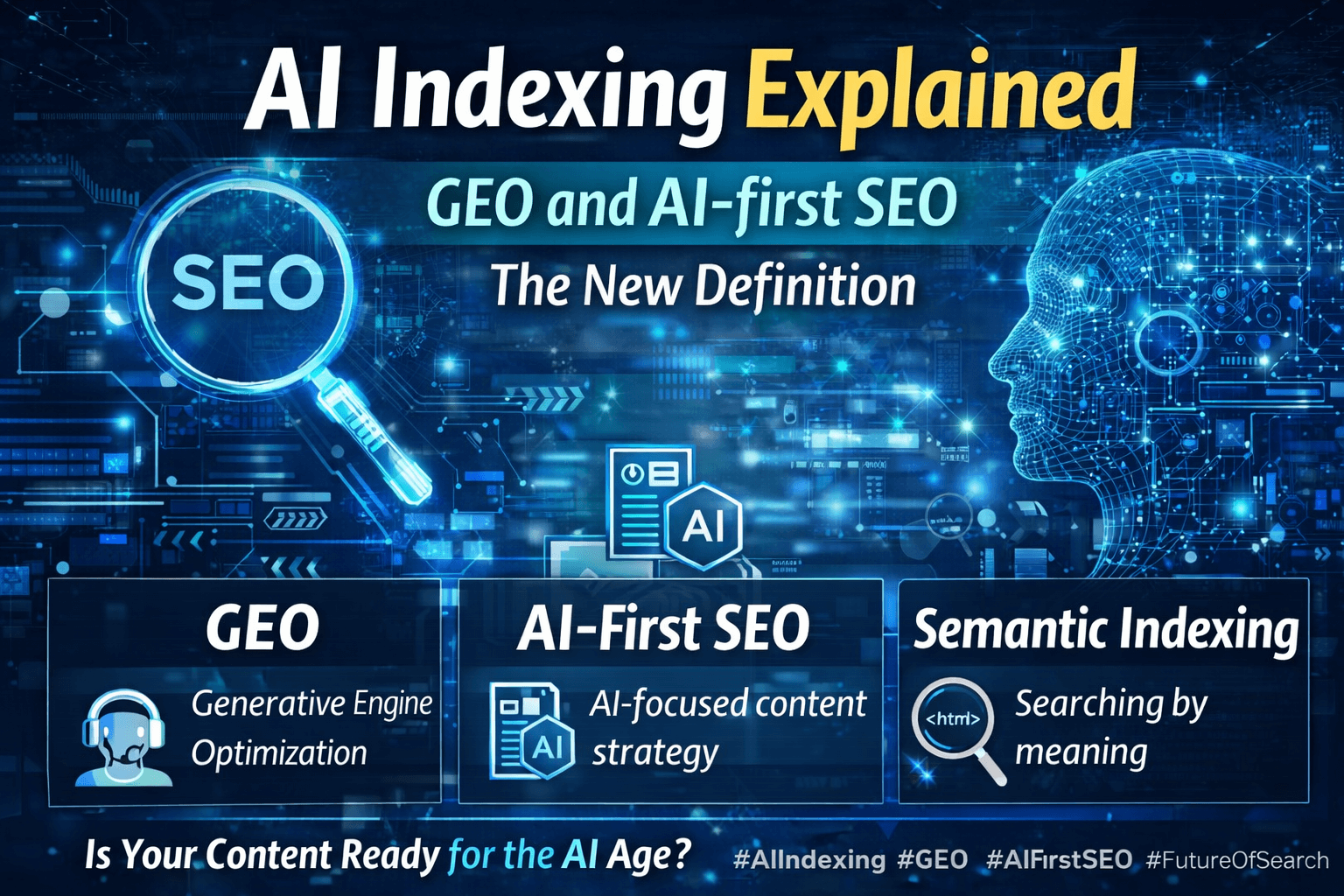
Terms like GEO (Generative Engine Optimization), AI-first SEO, and semantic indexing are reshaping how content is discovered, interpreted, and delivered.
So what do these concepts really mean? And why are they redefining the future of search?
This journalistic deep dive uncovers the true definition of AI indexing and what it means for websites, creators, and businesses.
A shift from search engines to answer engines
Traditional search engines like Google were built on indexing pages based on keywords, backlinks, and technical signals.
But with the rise of AI systems, the logic has changed.
We are entering the era of answer engines, where platforms no longer just list results — they generate answers.
What does this change imply?
- Content is no longer just ranked
- It is interpreted and reused
- Visibility depends on clarity and meaning
This is where AI indexing comes into play.
What is AI indexing: the real definition
AI indexing is the process by which artificial intelligence systems:
- Analyze content deeply
- Understand context and intent
- Extract useful information
- Recompose it into answers
Unlike traditional indexing, AI does not just store pages. It learns from them.
Key characteristics of AI indexing:
- Context-driven
- Semantic-based
- Intent-focused
- Dynamic and adaptive
👉 In simple terms: your content is no longer just indexed — it is understood.
GEO: Generative Engine Optimization explained
A new term is gaining traction in the SEO world: GEO.
What is GEO?
Generative Engine Optimization (GEO) refers to optimizing content specifically for AI-generated responses.
Instead of optimizing for rankings, GEO focuses on:
- Being selected by AI
- Being quoted in generated answers
- Providing high-value, reusable content
Why GEO matters today
AI tools like ChatGPT, Google SGE, and other assistants rely on high-quality sources.
If your content is well-structured and informative, it has a higher chance of being used.
AI-first SEO: a new strategic approach
AI-first SEO is not just a trend — it is a mindset shift.
Definition of AI-first SEO
AI-first SEO is the practice of creating content primarily for AI understanding, before traditional ranking.
It prioritizes:
- Clarity over keyword density
- Meaning over volume
- Structure over length
How is AI-first SEO different from traditional SEO?
Traditional SEO:
- Focus on keywords
- Optimize for ranking positions
- Target search engine algorithms
AI-first SEO:
- Focus on user intent
- Optimize for AI comprehension
- Target answer generation systems
👉 The goal is no longer just traffic — it is influence in AI responses.
Why AI indexing is transforming digital visibility
This evolution is not theoretical — it is already happening.
Major impacts:
- Zero-click searches are increasing
- AI-generated answers dominate results
- Authority is shifting from websites to content quality
What this means for publishers
If your content is not AI-friendly:
- It may not be visible
- It may not be used
- It may become irrelevant
What makes content AI-indexable?
To be effectively indexed by AI, content must follow specific principles.
Essential elements:
- Clear structure (headings, sections)
- Direct answers to questions
- Rich semantic context
- Simple and precise language
Example:
A well-structured explanation is more likely to be reused than a long, vague paragraph.
The rise of semantic authority
In the AI era, authority is no longer based only on backlinks.
It is based on:
- Expertise
- Clarity
- Consistency
- Depth of explanation
This is called semantic authority
It determines whether AI systems trust and reuse your content.
Is traditional SEO dead?
The short answer: no.
But it is evolving.
The new reality:
- SEO + GEO must work together
- Technical SEO still matters
- Content quality matters more than ever
👉 The winners will be those who adapt early.
The future of AI indexing
Experts agree on one thing: AI indexing will dominate the next decade.
Key trends:
- Conversational search will grow
- AI assistants will replace traditional queries
- Content will be consumed without clicks
Conclusion
AI indexing is not just a new concept — it is a fundamental transformation of the web.
Understanding GEO, AI-first SEO, and semantic indexing is now essential for anyone who wants to stay visible online.
👉 The future of SEO is not about ranking pages. It is about becoming a trusted source for AI.
— FAQ —
What is AI indexing?
AI indexing is how artificial intelligence analyzes, understands, and reuses web content to generate answers.
What does GEO mean in SEO?
GEO stands for Generative Engine Optimization, focusing on optimizing content for AI-generated results.
What is AI-first SEO?
AI-first SEO is a strategy that prioritizes content clarity and meaning for AI understanding rather than just rankings.
Is AI replacing traditional SEO?
No, but it is transforming it. Both approaches now need to work together.
— HASHTAGS —
#AIIndexing #GEO #AIFirstSEO #FutureOfSearch